


Tieline MPX Codec Options
Tieline’s MPX I and MPX II codecs deliver composite FM multiplex (MPX) codec solutions for real-time network distribution of FM-MPX or MicroMPX (µMPX) signals to transmitter sites. The MPX I is ideal for transmitting a composite STL signal from a single station with return monitoring, whereas the Tieline MPX II can transport two discrete composite FM-MPX signals from the studio to transmitters with return monitoring. Both units support analog MPX on BNC, MPX over AES192, and multipoint signal distribution, to deliver a wide range of flexible composite encoder and decoder solutions for different applications.
The MPX I and MPX II support sending the full uncompressed FM signal, or high quality compressed µMPX at much lower bit-rates. You can order an optional DVB-S2 satellite tuner card at purchase to support decoding DVB-S or DVB-S2 signals.
Significant Cost Savings Using Tieline MPX Codecs
Distribution of MPX composite signals from the studio or playout centre substantially reduces costs by eliminating expensive audio processing and RDS generation requirements at STL sites. Following is an example of a traditional STL link using IP codecs, which requires a processor and RDS encoder at the studio and transmitter site for each signal.
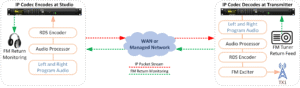
The next example shows how you can reduce equipment and save thousands by deploying MPX codecs for STL links, which significantly reduces hardware requirements at the transmitter site. The signal from the MPX decoder can be fed directly into an FM exciter at the transmitter site. Processors and RDS encoders are only required at the studio.

Typical Cost Savings
MPX codecs offer a unique advantage compared to traditional STL paths. They operate over IP and allow syndication from a single uplink point, eliminating the need for a more complex on-air signal path at each tower location. Multicast or multi-unicast distribution reduces costs further by replicating MPX composite streams using a single MPX I or MPX II encoder, similar to how baseband IP audio streams are replicated in audio codecs.
The cost of a typical RDS encoder and stereo generator/audio processor at each transmitter site can cost from $ 3,000 for cheaper brands, to $ 10,000 or more for high quality brands. This doesn’t include the reduction in running costs across several transmission sites. The cost savings in most cases will pay for new codecs in full! Simplifying transmitter site setups also means there will be less cabling, power, and maintenance costs.
In the following example a single MPX II codec sends 10 multi-unicast signals to transmitter sites, saving tens of thousands of dollars in RDS and processor costs.

Full remote monitoring and control is available using the HTML5 Toolbox Web-GUI and Cloud Codec Controller. Automated alarms and SNMP monitoring reduce the need for site visits too.
Other Benefits of Tieline MPX Codecs
- Support for analog MPX (BNC) or digital MPX over AES192 means MPX codecs can be used with analog transmitters and then transition to digital transmitters over time.
- Support for IP connections as well as MPX composite streams to provide flexibility. Stream IP audio and MPX to a single site (using the MPX II).
- MPX can be distributed to transmitter sites using wireless point-to-point STL links, managed networks and unmanaged Public WANs, and satellite links using MPEG-TS.
- Compressed µMPX composite signals can be distributed over WANs like the internet at bit-rates as low as 320kbps to reduce bandwidth requirements.
Want to know more about Tieline products and software?
For more information about the MPX I and MPX II and other Tieline codecs visit www.tieline.com/products or contact Tieline sales:
- For USA, Canada & Latin America contact: sales@tieline.com
- For Australia and International: info@tieline.com


